

ST. CHARLES Mo.- As Lindenwood University looks to the future of campus housing, university leadership says its approach is grounded in long-term planning, modernization and a strong focus on the needs of students
Diane Moore, Senior Vice President of fiscal affairs at Lindenwood, said the university’s wide range of housing options reflects a deliberate effort to respond directly to what students want.
“The University understands students want choice,” Moore said. “To the extent possible, providing flexibility will hopefully enhance the college experience for our students.”
That philosophy has shaped a housing strategy that balances a significant commuter population from the local St. Louis and Wentzville areas, with the needs of residential students. While many students live off campus, Moore emphasized that the university continues to invest in improvements already on campus.
The black icons represent all university-owned houses. Yellow markers indicate freshman residence halls, while green markers denote upperclassman housing. Purple icons identify residence halls on the Heritage side of campus. Parker Hall and Linden Lodge are marked with an ‘X’ to indicate that these facilities are either closed or undergoing renovation.
“The University tries to provide upgrades and enhancements for existing housing each year,” she said. “This is based upon available funding and focusing on campus-wide priorities. While we have a prominent commuter population, we always want to provide options that meet our students’ wants and needs.”
Central to that strategy is a comprehensive campus master plan that guides future development.
“The University engaged in an extensive campus master plan,” Moore said. “This plan addresses academic, athletic and housing needs. The final plan recommends construction of new housing options over several phases.”
That plan includes both new construction and renovations of existing facilities. One example is Parker Hall, which is next in line for major upgrades.
“Parker Hall will be the next Heritage residential hall to undergo major renovations,” Moore said. “These unique buildings need new plumbing lines, renovated restrooms, flooring and other renovations to provide updated housing options for our residential students.”
The timing of these renovations will depend upon the projected occupancy needs for student housing.
Recent housing decisions have also drawn attention, particularly the closure of Linden Lodge. Moore said the decision came after weighing multiple factors.
“First, the ability to provide housing to all students on campus through residential halls and the Linden Terrace housing provided the opportunity to consider closing Linden Lodge,” she said. “The physical condition of Linden Lodge was becoming an ongoing concern.”
The university announced the closing of the Lodge in late February which left students scrambling to find roommates as the housing applications for the next school year opened in March.
“If you want to live in a house, one you have to find people who want to live with you and two you have to find people who aren’t already living in a house.” Jacob Stanoch, a junior at Lindenwood said in an interview with reporter Anna Ince.
“I had a problem with mold in the vents and had to keep my bathroom fan running all day.” Stanoch said about the challenges faced of living in the older building.
Utilities and maintenance posed not only an issue for the university but also for students residing in the lodge.
“All the people in the dorms were complaining about their AC not getting turned on. But each room has its own AC you can run whenever.” Jed West said, a sophomore at Lindenwood said about the perks of the rooms in the lodge.
“It was nice to have my own downtime and not have to worry about a roommate or three other people to live in a house with.” Stanoch said about the Linden Lodge offering single rooms.
With the lodge closing and removing over 100 single rooms, students looking to live in a single next year will have to move into Blanton Hall, Cobbs Hall or Ayres Hall for females for anyone still looking for a single or other dorms if a student has any medical accommodations.
Ince sat down with Stanoch, West and Aidan Knapke, three students who currently live in Linden Lodge to discuss how the closing of the facility affected their future housing decisions as well as what their reaction to the closure was with the full interview can be listened to here.
The Lodge offered a unique living experience for students as it is located adjacent to the Wal-Mart shopping area in St. Charles, and within walking distance of several popular restaurants including: Applebee’s, Black Bear Diner, Popeyes, Chick-Fil-A, Chipotle and Jersey Mike’s.
Ultimately, the move aligned with broader planning goals.
“Based upon existing occupancy opportunities on campus and the future direction outlined in the campus master plan, it made sense to move away from this property,” Moore said.
Looking ahead, housing capacity will also be influenced by new leadership. Aaron Voyles will begin his role June 1 as the new Vice President of student affairs, and is expected to help guide future decisions.
“He brings a wealth of residential life experience and will work closely with the President and Cabinet as we determine student housing needs,” Moore said.
The campus master plan outlines a possible direction for other buildings on campus that are currently closed but still offer a value to the university, like Butler Hall.
“The campus master plan recommends consideration of a visual arts facility to connect with the Makerspace currently being used,” she said. “This could happen in one of the subsequent phases of the plan.”
Financial considerations also play a key role in housing decisions.
“Deferred maintenance for the entire campus is monitored annually. This includes all housing,” Moore said. “Understanding the needs of residents and the type of housing students desire are two of the many factors that enter into this assessment.”
Student preferences are also shaping future development, particularly in areas like Linden Terrace.
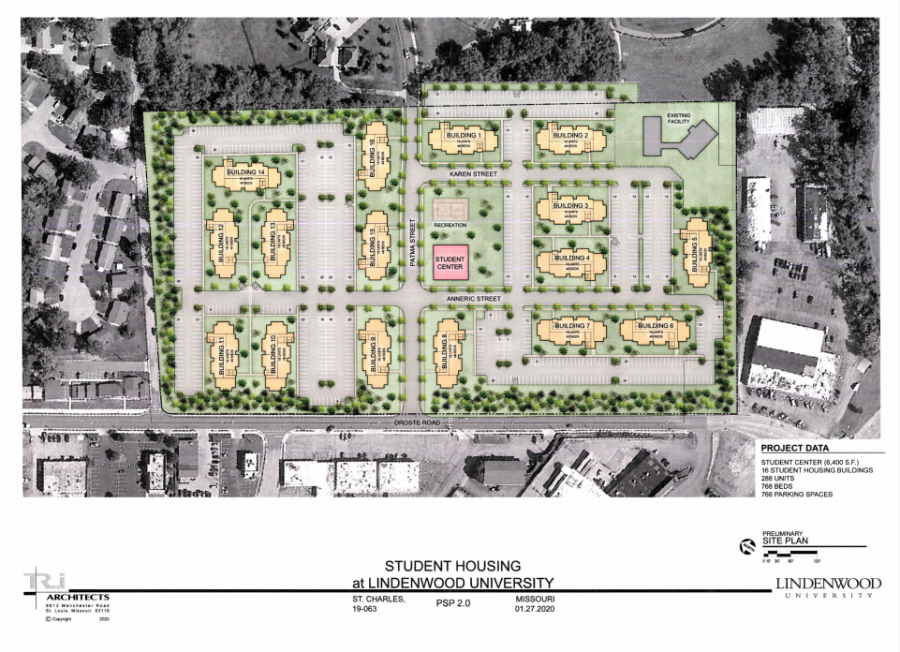
“The University maintains almost 200 houses,” Moore said. “The campus master plan provides a recommendation to convert multiple blocks of houses owned by the University into modern student apartments.”
Efficiency could be improved if this plan goes into place and helps better the university for future expansion.
“While these apartments will not replace all of the houses owned by the University, this type of student housing could be more cost effective and efficient to maintain,” Moore said.
Lindenwood students were excited to hear about what the future of Linden Terrace holds while also staying cautious until something concrete is announced.
“If you’re able to fit more people in and have it state-of-the art with amenities and everything, then I say do it.” Stanoch said about the plan to transform Linden Terrace.
The university is trying to be proactive vs reactive when it comes to making projections on the future of Lindenwood housing and student population.
“Understanding residential student projections is a defining factor regarding the timing of construction,” Moore said.
As Lindenwood navigates changing student expectations and financial realities, that balance of renovation and new development is expected to shape the future of campus housing.
“The campus master plan outlines the long-term vision for campus housing,” she said. “Renovating existing residential halls and modernizing student housing, perhaps by constructing new apartments, are priorities.”
For the future, Lindenwood is focused on catering to students’ needs and has an open mind when it comes to the future and weighing plenty of options when making decisions when it comes to what the future holds for on campus housing.